


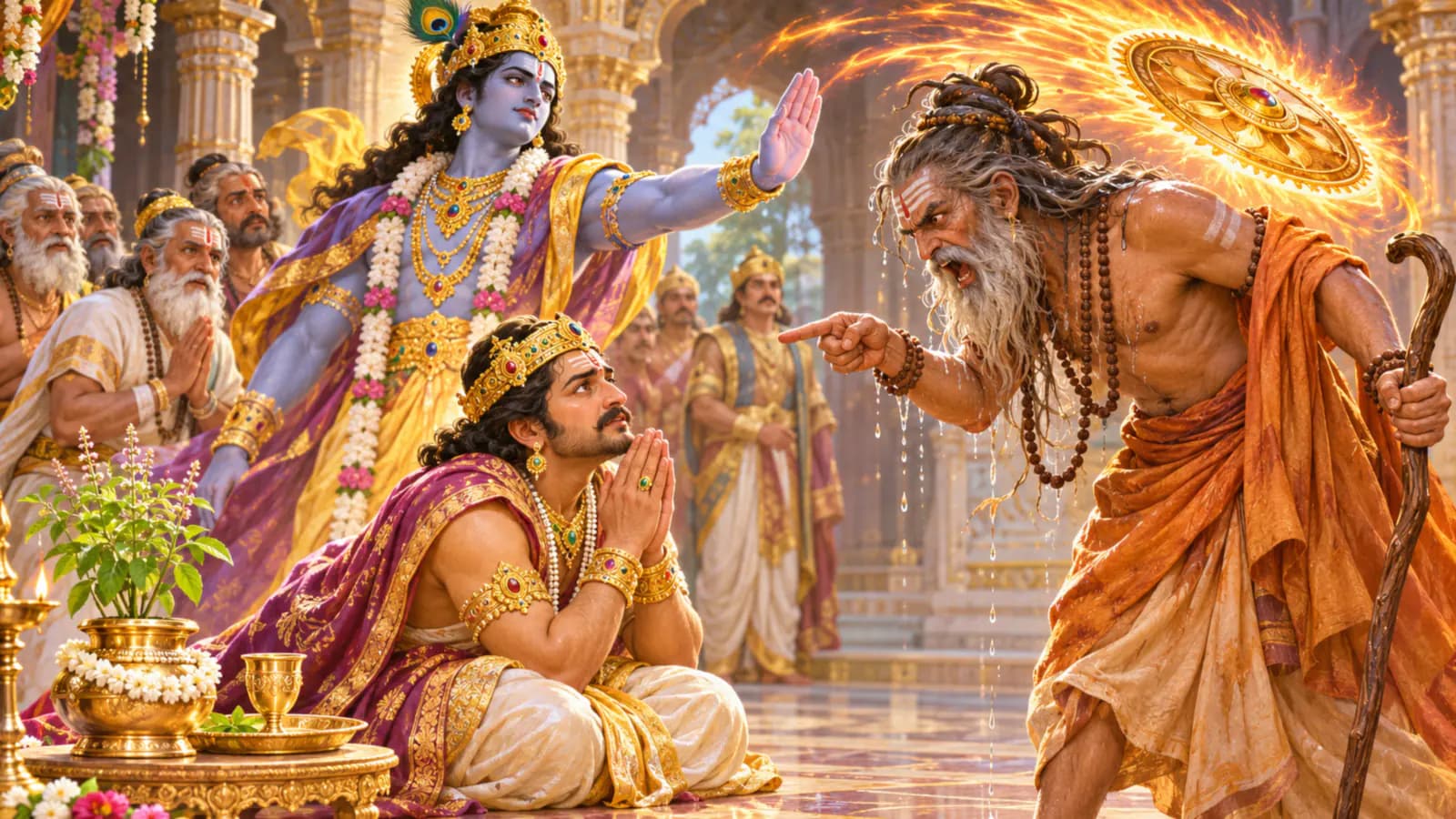
A sage walks back from the river, water still dripping from his matted hair.
He steps into the palace hall. And he stops.
The king has just taken a sip of water.
The sage's eyes go red. His whole body shakes with rage. "You ate… before me?"
It was only a sip of water. What could one sip of water possibly cost?
The King's Dilemma at Dwadashi
Yesterday, King Ambarisha had to break his Dwadashi fast before the holy time ran out. But his guest, the fiery sage Durvasa, had gone to bathe in the river and had not come back. And the king's scholars could not tell him what to do.
At last the scholars spoke.
"Great king, a trouble like this comes from some sin in a past life. We cannot choose for you. You must decide."
Ambarisha thought hard. And he found a way.
Not a meal. Only water.
By tradition, sipping water counts as eating, and also as not eating. A sip would complete his Dwadashi vow. And yet he would not have sat down to a meal before his guest. No broken vow. No insult to the sage.
So, with his mind on Narayana, he took the tulasi water kept before the Lord… and sipped it.
Durvasa's Wrath and Ten Curses
At that very moment, Durvasa walked in.
He saw. And his face changed. His anger blazed up, terrible, like Rudra himself.
"You've fallen from dharma!" he thundered. "You invited me. And then you ate before me! Don't you know that even water counts as food? This is an insult. A grave sin. Narayana never tolerates an insult to a brahmin. Insult a guest, a brahmin, a sage, and you insult Vishnu himself."
"You're puffed up with pride. Pride in your kingdom. Pride in your wealth. Even pride in your devotion. How were you ever born into such a pure family?"
Ambarisha trembled. He folded his hands and bowed low.
"Great sage, if I have sinned, I sinned without knowing. Calm is a brahmin's nature. Please… forgive me."
And he fell at Durvasa's feet.
But Durvasa's anger only grew. He kicked the king away with his left foot.
"Other sages soften when someone begs," he said. "Not Durvasa. No one who wrongs me escapes my curse."
And he cursed.
"You will be born ten times. And every birth will break your pride. A fish. A tortoise. A boar. A lion. A dwarf. A cruel brahmin. A king without wisdom. A king without a kingdom. One who walks outside the path of the Vedas. And a pitiless brahmin."
Ten curses. On a king whose only fault was a sip of water.
But even that was not enough for Durvasa. He drew breath to curse again.
The Sudarshana Chakra Pursues the Sage
And then something happened that no one in that hall could see.
Ambarisha's mind was on Narayana. And Hari himself was dwelling in his devotee's heart. From there, the Lord spoke to the sage.
"Durvasa… I will gladly bear your curse."
Still Durvasa's fury would not cool. Soft words were useless now. And this offence had to be checked.
So Hari released his own weapon. The Sudarshana chakra. The discus of Vishnu.
It came at Durvasa blazing like ten million suns. Spitting flames.
And the great sage… ran.
He ran for his life. Through all three worlds. And wherever he ran, the chakra was right behind him.
He begged the great sages to save him. They could not. He ran to Indra, king of the gods. Indra could not. He ran to Brahma, the creator. Brahma could not. He ran to Kailasa, to Shiva himself.
Even there… there was no shelter from that blazing wheel.
What This Chapter Asks of Us
Notice what Ambarisha did through all of this. He didn't argue. He didn't fight. He didn't even defend himself. He bowed, and he kept his mind on Narayana. And the Lord who lived in that mind stepped in front of the blow.
And notice Durvasa. Great austerities. Great power. And one fit of anger threw all his judgement away. That is the warning in this chapter: anger destroys even an ascetic's wisdom.
This chapter also gives a practice. When a full meal isn't possible within the Dwadashi time, even a sip of water completes the parana. So if Dwadashi is short, don't let it pass. At the very least, sip a little water, thinking of Narayana.
Read next
- Karthika Puranam – all 30 days
- Previous chapter: Karthika Puranam Day 24: The Guest Who Did Not Return
- Start from Day 1: Karthika Puranam Day 1: The River in Every Well
- Why Karthika Masam Is So Sacred: Meaning and Key Days
- Why We Light a Lamp (Deepam): Meaning, Oil, Wicks and Rules
- How to Do Tulasi Puja at Home: Method and Rules