


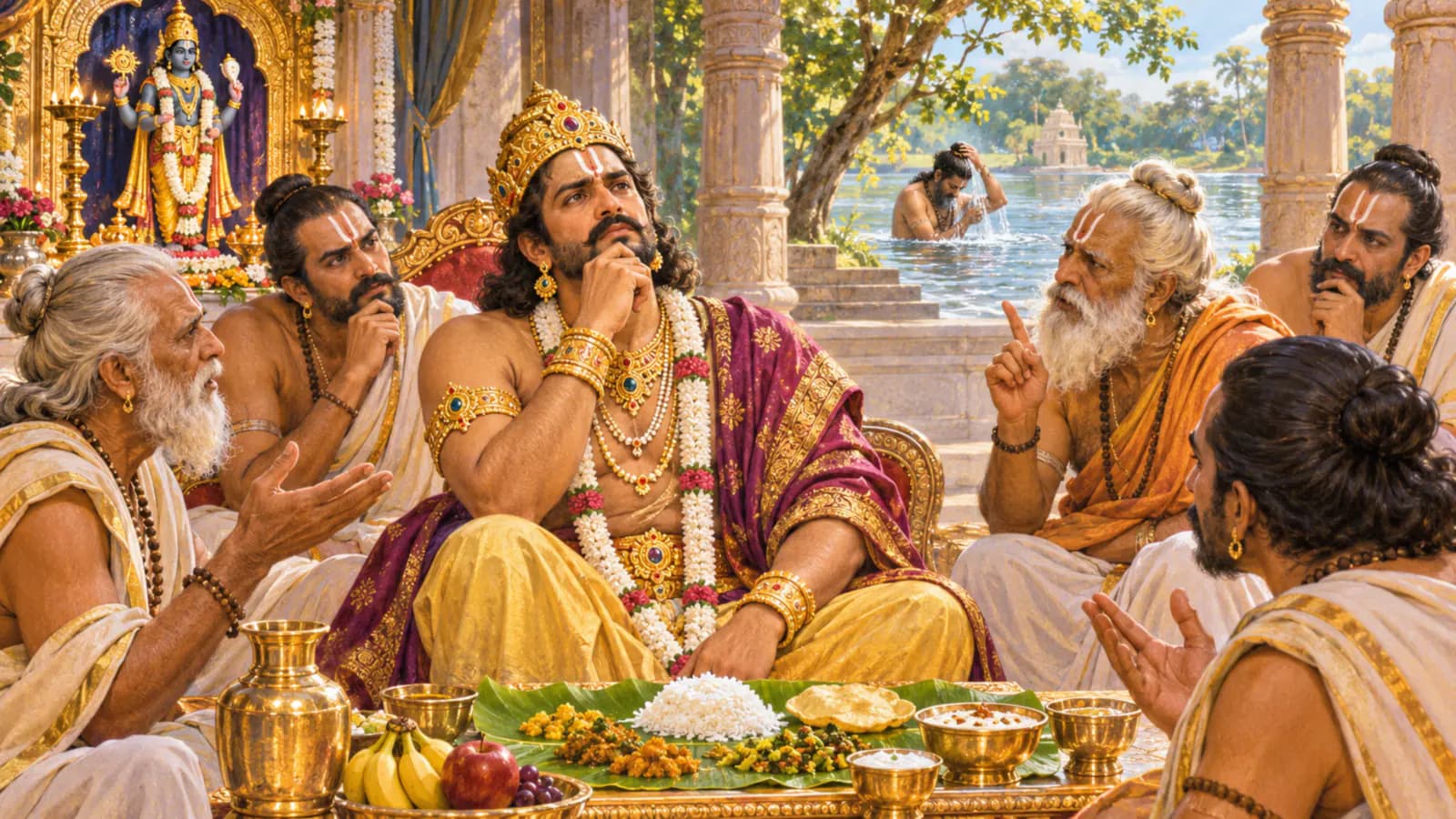
A king sits in front of a meal he cannot touch.
He fasted all of yesterday. Now the holy time to break that fast has come. And it is short. Very short. It will be gone in a little while.
But his guest has gone down to the river to bathe. And he has not come back.
That guest is Durvasa. The most short-tempered sage in all the worlds.
If the king eats now, he insults the sage. If he waits, his sacred vow is broken.
Every moment, the time is slipping away… What will he do?
Today begins the story of King Ambarisha, and of one Dwadashi that tested him like nothing else. It will take us six days to tell.
Atri on the Karthika Dwadashi Vow
Vasishtha is still telling King Janaka what the sage Atri once told the sage Agastya. And Atri said, "The greatness of Karthika can never be told in full. Those who hear it never tire of it. And neither do those who tell it."
Then he spoke about one day in particular. The Dwadashi of Karthika, the twelfth day of the bright half of the month. It is also called Haribodhini.
"Keep the vow of this one Dwadashi," Atri said, "and you gain the merit of bathing in many holy rivers and visiting many holy places."
The vow itself is simple. On Ekadashi, the eleventh day, you fast completely. On Dwadashi, the next day, you offer food to Hari, and then you break your fast. That meal is called the parana.
But there is one strict rule. The parana must be done while Dwadashi lasts. Even if Dwadashi lasts only a short time.
Remember that rule. This whole story turns on it.
King Ambarisha Welcomes Durvasa
Ambarisha was a great king. And more than a king, he was a great devotee of Vishnu. He kept this vow on every single Dwadashi. He never missed one.
One time, Dwadashi was going to last only a very short time. So Ambarisha hurried. He finished his worship early, so that he could feed the brahmins and break his fast before the time ran out.
And just then… a visitor arrived at the palace.
It was Durvasa.
Every king knew that name. Durvasa was a mighty sage, full of the power of his austerities. And he was famous for one thing above all. His temper.
Ambarisha bowed to him. "Great sage, you've come at a blessed moment. Please be my guest. Share my Dwadashi meal with me."
Durvasa agreed. "First I'll bathe," he said, "in the river nearby." And he walked away toward the water.
The king waited.
The food was ready. The brahmins were waiting. Dwadashi was slipping away.
And Durvasa did not come back.
A King Torn Between Two Duties
Ambarisha's mind was torn in two.
"I invited him," he thought. "If I eat before my guest, I insult a brahmin. For a householder, that is a great sin. And this sage is quick to anger. He'll curse me."
"But if I wait, Dwadashi will pass. My vow will break. My Ekadashi fast will be wasted. And Lord Vishnu will be displeased. The wise say that if this rule is broken, the merit of many past lives is lost. And there is no atonement for it."
Then a deeper thought rose in him.
"A brahmin's curse… yes, I fear it. But I fear losing my devotion to Hari far more. If a curse comes, Hari will protect me."
Still, he would not decide alone. This was a very fine point of dharma. So he called the learned scholars of his court.
"Tell me," he said. "What is right?"
The scholars talked among themselves.
Some said, "A host must never eat before his guest. Not even if the guest is the humblest person at the door. How much more when the guest is a great sage like Durvasa. Insult him, and you can lose your wealth, your good name, even your life."
Others said, "But Durvasa promised to come, and he hasn't come on time. That's not right either."
"And if the Dwadashi parana is missed, the whole Ekadashi fast is spoiled."
Both wrongs were grave. Neither had any atonement. They weighed one against the other… and they could not decide. Either way, harm would follow.
They looked at one another. And they fell silent.
And outside, Dwadashi was running out.
What This Chapter Asks of Us
Notice the kind of trouble this is. Ambarisha has done nothing wrong. He kept his vow. He welcomed a guest. And still he stands between two duties pulling in opposite directions. That's how precious Atri says this Dwadashi is. A great king would rather risk the anger of Durvasa than let it pass.
Today's practice comes straight from this chapter. If you keep the Ekadashi fast, break it on Dwadashi while Dwadashi lasts, however short it is. Your panchangam will tell you when it ends.
Read next
- Karthika Puranam – all 30 days
- Previous chapter: Karthika Puranam Day 23: The Road to Srirangam
- Start from Day 1: Karthika Puranam Day 1: The River in Every Well
- Why Karthika Masam Is So Sacred: Meaning and Key Days
- Why We Light a Lamp (Deepam): Meaning, Oil, Wicks and Rules
- How to Do Tulasi Puja at Home: Method and Rules