


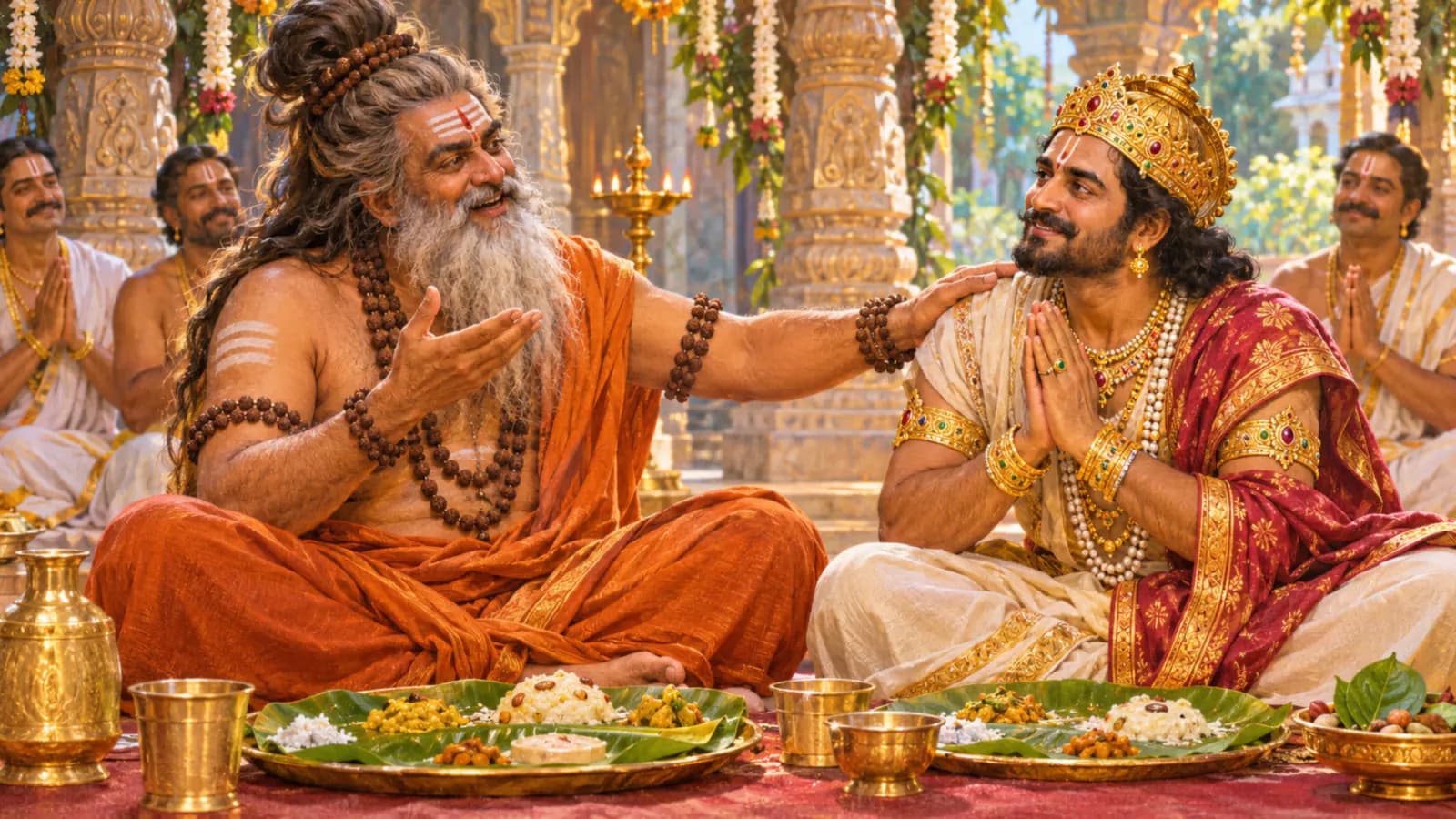
The most feared sage in the three worlds looks at a king. The same king he cursed to ten births. The same king he kicked away with his foot.
And he says, "You are my father."
Then he tells the king a secret. Something he has kept hidden through this whole story.
Why would Durvasa call a king his father? And what was the secret?
So far: the sage Durvasa cursed King Ambarisha for a sip of water on Dwadashi, and Vishnu's discus chased him through the three worlds. Sent back by Vishnu, he fell at the king's feet. At the king's prayer, the chakra stopped, blessed them both, and vanished.
A King Bows Before the Sage
Now the hall was quiet.
Ambarisha fell at Durvasa's feet.
"Great sage, you are born of a portion of Rudra himself. It was only my good fortune that brought you to my house on a Dwadashi. These troubles came from my own past karma. I'm an ordinary householder, drowning in this world, longing to be free. I don't know dharma. Forgive me. Accept my hospitality. Eat the Dwadashi meal. Bless me. And teach me the way to liberation."
Durvasa's heart filled with joy.
"Among all those born as kings and warriors, I've never seen anyone like you. Most kings show either pettiness or mere valour. But you have the virtues of a true brahmin. Peace. Truth. Non-violence. Goodness like this comes from merit earned over many births. You are blessed."
Then Ambarisha washed the sage's feet with cool water. And he sprinkled that water on his own head. Durvasa blessed him.
And at last… the meal.
Durvasa sat down to the Dwadashi parana. Five kinds of dishes, and sweet rice, served with every proper rite. And the king, who had been fasting in grief, sat and ate with him. Afterwards, Ambarisha offered him betel leaf scented with camphor.
Why Durvasa Called Ambarisha Father
When the meal was over, Durvasa spoke.
"You know the heart of the scriptures. Peace of mind. Steadiness. Constant remembrance of God. They all live in you."
"You saved me. Nowhere in the three worlds could I find safety. Not in heaven. Not on Kailasa. Not even in Vaikuntha. The chakra spared me only because your prayer pleased it."
"The scriptures say that one who saves a life is a father. So you are my father."
Then he smiled. "But you missed one fine point of dharma. You bowed to me. It pained me. I didn't stop you, only because I didn't want to upset you."
"Now listen. The knowledge of Brahman, the highest truth, is very hard to win. Even by studying every Veda. Even by keeping every vow. But it comes easily through compassion for all beings. Through humility. A tender heart. Contentment. Honouring guests and those in need. And a pure mind."
And then this great sage said something about himself.
"Durvasa does not yet know Brahman. I'm not there yet. Today I am happy only because I've eaten your parana."
The Test Hidden Behind the Curse
Then he looked at the king.
"Ambarisha, you are no ordinary man. Do you know why all this happened? Narayana himself told me to do it. All of it. To test your devotion."
"And now it is proven. In all the fourteen worlds, there is no greater devotee than you."
The late return from the river. The curse. The chase through three worlds. All of it… was a test.
Then Durvasa taught the king the paths to liberation. He took his leave. And he went off to wander the worlds.
Atri finished the story for Agastya. "All this happened on a Karthika Dwadashi. Whoever keeps the Dwadashi vow gains knowledge of the Self and final liberation, and is freed from rebirth."
And Vasishtha said to King Janaka, "You too, Janaka, keep the Karthika vow. Fast on Ekadashi. And break the fast on Dwadashi."
What This Chapter Asks of Us
Notice who gives this story's last lesson. Durvasa. The sage of terrible austerities. And he says the highest knowledge doesn't come from books or vows alone. It comes from a kind heart, from humility, and from caring for the guest at your door. He learned that from a king who stood between him and the wheel of fire.
At the end of this chapter, the storyteller Suta adds a gentle word for anyone who feels they can't do much. If you can't keep the whole Karthika vow, do what you can. At least bathe, and light a lamp in a temple. If you can't light a lamp, at least bow to one. And if not even that, listen to the Karthika Purana on the holy days.
Read next
- Karthika Puranam – all 30 days
- Previous chapter: Karthika Puranam Day 28: The King Who Faced God's Discus
- Start from Day 1: Karthika Puranam Day 1: The River in Every Well
- Why Karthika Masam Is So Sacred: Meaning and Key Days
- Why We Light a Lamp (Deepam): Meaning, Oil, Wicks and Rules
- How to Do Tulasi Puja at Home: Method and Rules