


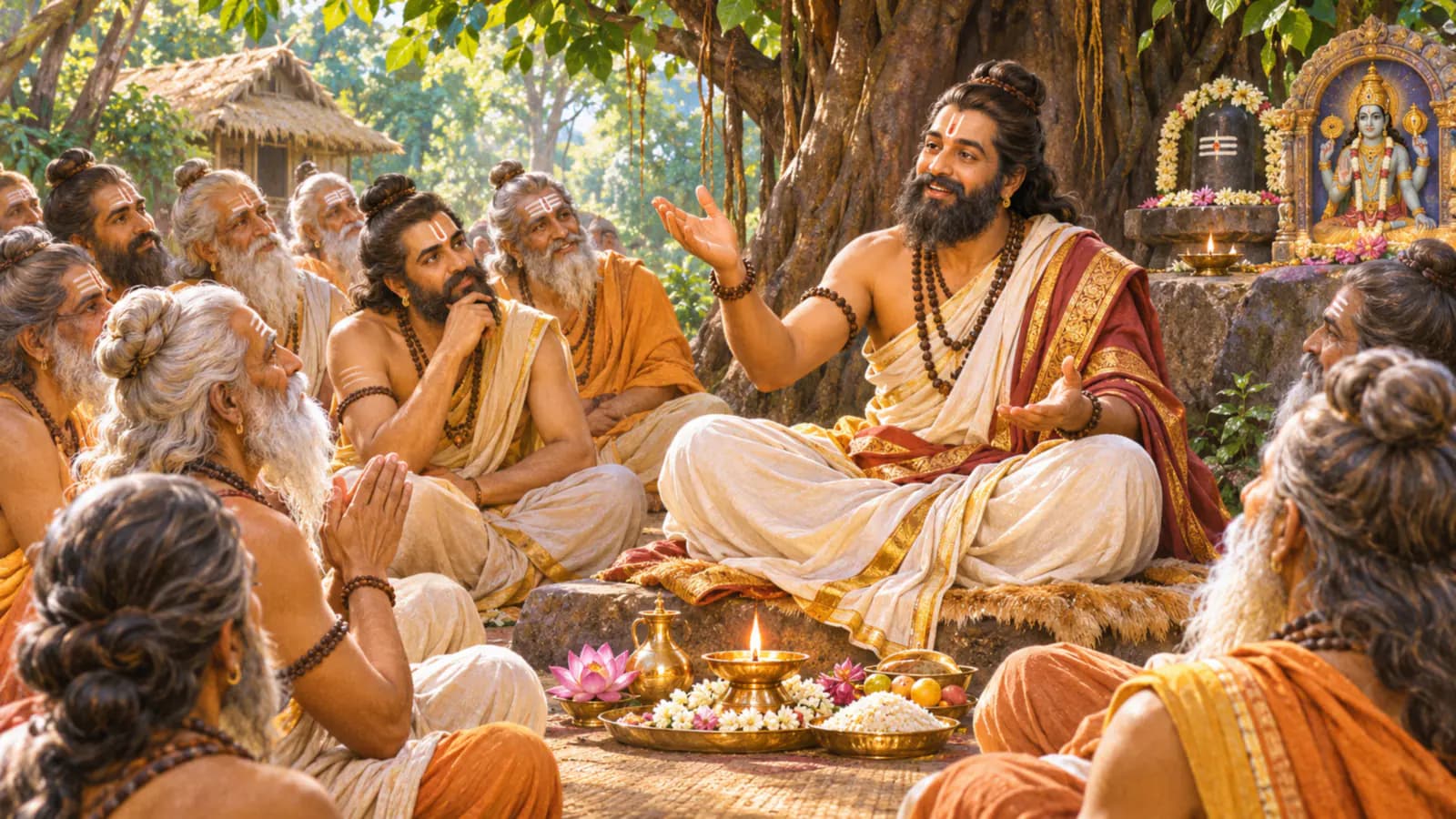
In the forest of Naimisha, the sages have listened for a whole month.
Thirty chapters. Thirty stories. Kings and thieves. Demons and devotees. Lamps lit in love, and lamps lit by accident.
And now, at the very end, they ask the storyteller Suta one last question. Maybe the most honest question of all.
"Suta… this is the age of Kali. People are weighed down by wrongdoing. Their minds are restless. Their bodies are worn out by illness. How can ordinary people like this ever cross the ocean of birth and death? Is there an easy way?"
What would you answer? After thirty days… what is the one thing to carry home?
The Sages Ask Their Final Questions
With today, our thirty days of Karthika come to a close. So it's fitting that the last word goes to Suta, the storyteller who began this whole Purana for the sages of Naimisha.
The sages had heard the stories of Karthika, and of the devotees of Vishnu. They praised them. And then they asked their questions.
"In this age of Kali, which dharma is the highest? What leads to liberation? Who is the highest god? What act destroys delusion? And for people whom death follows every moment… what is the easy way?"
Suta was happy.
"These are good questions," he said. "These are the questions everyone should ask. Asking them, hearing the answers, and living by them… that itself cuts a person's bonds."
And then Suta said the line that gives this chapter its name.
"Even with a thousand mouths, no one could tell the full greatness of Karthika."
A Vow Within Everyone's Reach
Then he answered them.
"Many people perform great sacrifices. They keep vows, chant mantras, give large gifts and feed brahmins. And through all that, they reach liberation, and they help the world too. But not everyone can do these things."
Not everyone has the wealth. Not everyone has the time, or the strength.
"For such people, the Karthika vow is enough. Anyone can reach it."
"The Karthika vow gives the fruit of great sacrifices. It gives the fruit of good company. It gives the fruit of charity. It destroys every sin, and frees a person from being born again."
"Karthika is dear to Shiva. It is dear to Keshava. Dear to Hari and to Hara, both. That is why the scriptures, and all eighteen Puranas, praise this month so highly."
Notice that. Thirty days ago, on the very first day, Vasishtha told Janaka the same thing. Karthika is dear to Vishnu, and dear to Shiva. Look down on no one. The Purana ends exactly where it began.
And then Suta gathered the whole vow into a few simple acts.
"From the day the Sun enters Tula, bathe in a sacred river. The Kaveri, the Ganga, the Godavari. Worship Shiva and Vishnu. Light lamps of cow's ghee in their temples, all month long. Sing the names of God. Give gifts, as much as you can. And in the evening, read or listen to this Purana."
"Many great souls did just this. Their sins were washed away. Every good fortune came to them. And when their lives ended, they reached the feet of Hari."
And then Suta gave the promise that closes the whole Karthika Purana.
"Whoever keeps this vow… or simply hears or reads the greatness of Karthika… receives every blessing in this life, and in the end, reaches Vaikuntha."
A Bath, a Lamp, a Name
That is the answer to the sages' question. The easy way, in the age of Kali, is not a hard way at all. A bath. A lamp. A name. A gift. A story heard with an open heart.
Think back over this month. A woman born again and again as a dog, set free by one Monday. Three demons in a tree, freed by one man's morning bath. A hungry mouse that grabbed a wick, and lit a lamp without knowing it. Ajamila, saved by calling his son's name. A greedy king who became a pilgrim. And a king who kept his Dwadashi vow, even when it meant facing the angriest sage alive.
Not one of them was perfect. Many of them didn't even mean to do good. And still, Karthika found them.
What This Chapter Asks of Us
The chapter asks one last thing of us, at the close of the month. Give something, as much as you can. And feed a learned brahmin, within your means. Let the month end with a full plate in someone else's hands.
And if you have kept even part of this vow with us, a bath, a lamp, a story… this last promise of the Purana is for you too.
Thank you for walking these thirty days with us.
The month is over. But the lamp doesn't have to go out.
Read next
- Karthika Puranam – all 30 days
- Previous chapter: Karthika Puranam Day 29: The Sage Who Called a King Father
- Start from Day 1: Karthika Puranam Day 1: The River in Every Well
- Why Karthika Masam Is So Sacred: Meaning and Key Days
- Why We Light a Lamp (Deepam): Meaning, Oil, Wicks and Rules
- How to Do Tulasi Puja at Home: Method and Rules