


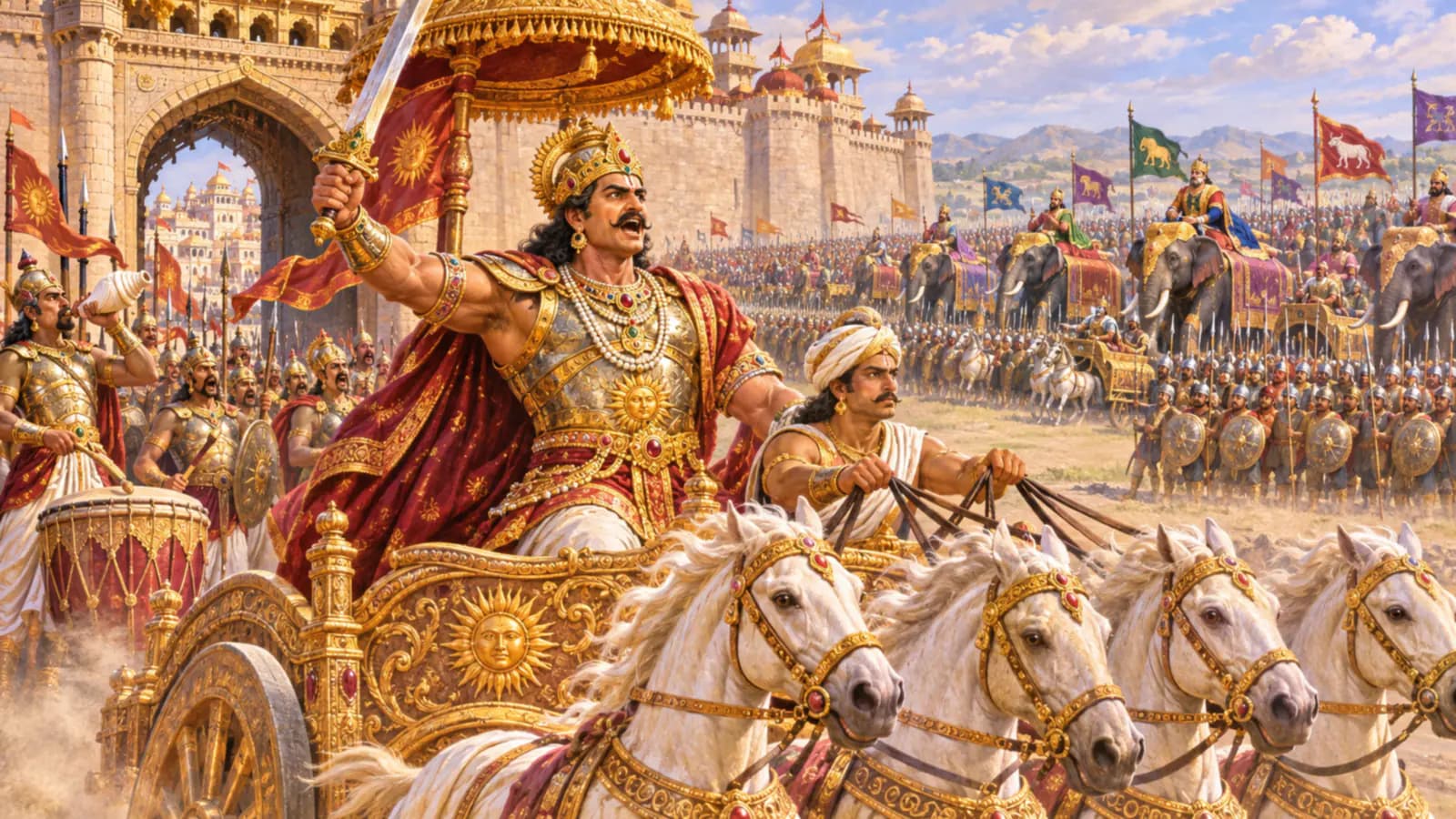
The city of Ayodhya is surrounded.
On every side, as far as the eye can see… armies. Chariots. Elephants. Horses. Rows and rows of foot soldiers. The kings of the neighbouring lands have joined hands, and they have come for one man.
The king of Ayodhya.
And inside the city, that king is not afraid. He puts on his armour. He climbs into his chariot. The war drums begin to beat. He roars like a lion… and rides out through the gate, straight at them.
Who is this king? And how did a ruler of Ayodhya, a king of the line of the Sun, end up with the whole world at his gates?
Today a new story begins, one that will run for four days. The story of King Puranjaya.
An Old Conversation Between Two Sages
Vasishtha told King Janaka of an old conversation between two great sages. The sage Agastya asked, and the sage Atri answered.
Atri was pleased with the question. "Agastya," he said, "there is no month like Karthika. No scripture like the Veda. No wealth like good health. And no god like Hari. In this month, a bath in a river, a lamp in a temple of Shiva or of Vishnu, the worship of Hari… these fulfil every wish. Listen to what happened to a king who forgot that."
Puranjaya, King of Ayodhya
Long ago, in the Treta age, a king named Puranjaya ruled the city of Ayodhya. He belonged to the Solar dynasty, the great line of kings descended from the Sun.
Puranjaya was learned. He knew the scriptures. And in the beginning, he was a just king. He defeated the kings around him, and his treasury filled with wealth.
The Slow Slide Away From Dharma
And that is where it began to go wrong.
The more he had, the less he could think clearly. Wealth brought pride. Pride brought greed.
There were lands that earlier kings had given to temples, and to brahmins, so that the worship of God and the work of learning could go on. Puranjaya took those lands for himself. He took other kings' kingdoms by trickery. He put heavy taxes on his people. He began to hate brahmins.
He gave up truth. He gave up purity. And he made friends with thieves.
A king is supposed to protect his people from robbers. Under Puranjaya, robbery spread across the land.
Notice how it happened. Puranjaya didn't wake up one morning as a bad king. First came wealth. Then pride. Then greed. One step at a time, he walked away from dharma… and didn't even notice he was walking.
The Neighbouring Kings March on Ayodhya
The kings around Ayodhya noticed.
They saw the lawlessness. They saw the gods insulted and the brahmins mistreated. And they were alarmed. So they met together and took counsel. At their head was the king of Kambhoja.
"This cannot go on," they said.
Each of them gathered his army. Chariots. Elephants. Horses. Foot soldiers. The full fourfold army of a king. And together they marched on Ayodhya and surrounded it on every side.
Puranjaya's spies brought him the news.
Another king might have trembled. Another king might have asked himself, "What have I done to bring this on?"
Puranjaya did not.
He was not afraid at all. He gathered his own fourfold army. He armed himself. He mounted his chariot, loaded with weapons. He had the war drums beaten. Conches blew. He roared like a lion.
And Puranjaya rode out of the gate of Ayodhya… straight into the enemy.
And here, today's chapter ends.
What This Chapter Asks of Us
What does this story show us? Atri began with it: no wealth like health, no god like Hari. A king who has Hari has everything. A king who seizes what belongs to God, and to those who serve God, has already started to lose, even if his treasury is full. Wealth that comes by adharma does not stay.
And notice what Atri set right beside that warning: Karthika. In this month, the way back to Hari is open to everyone. A bath. A lamp. A prayer. As we'll see, even for a king like Puranjaya.
So today, do what Atri praises. Bathe early, and light a lamp in a temple of Shiva or of Vishnu.
Read next
- Karthika Puranam – all 30 days
- Previous chapter: Karthika Puranam Day 19: The Sage Who Asked for Nothing
- Start from Day 1: Karthika Puranam Day 1: The River in Every Well
- Why Karthika Masam Is So Sacred: Meaning and Key Days
- Why We Light a Lamp (Deepam): Meaning, Oil, Wicks and Rules
- How to Do Tulasi Puja at Home: Method and Rules