


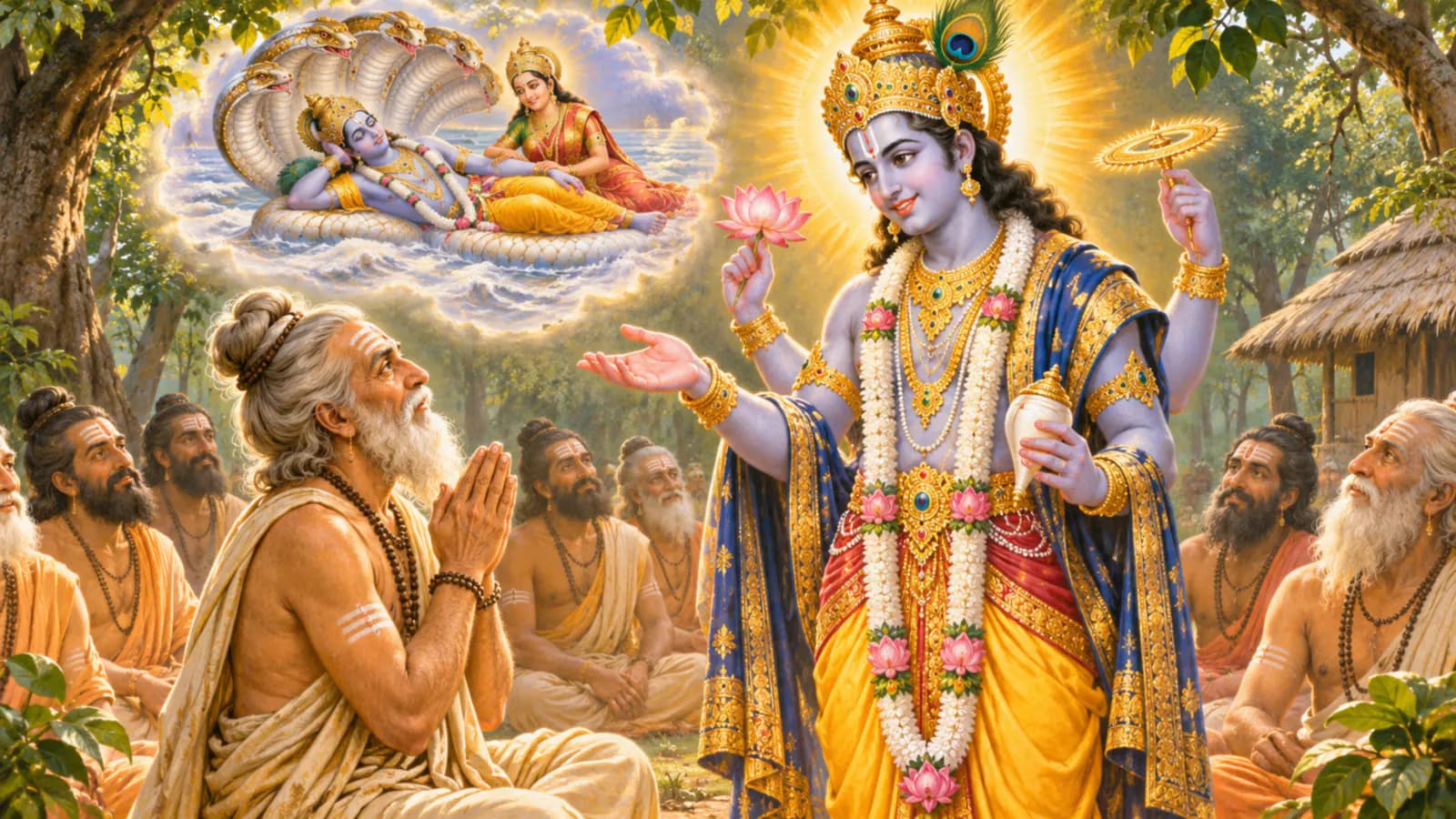
The Lord of the universe stands in a forest, shining like a crore suns.
He looks at an old sage and says, "I am pleased with you. Ask me for a boon."
Anything. Wealth. Power. A long life. Anything at all.
And the sage says, "We want nothing."
Then the Lord tells him something even more surprising. "Every year I lie down for four months. But I do not really sleep."
Then why does he lie down? And what is he waiting to see?
The Sages of the Naimisha Forest
Let's remember where we are. Vasishtha is telling King Janaka a story. In that story, the sage Angirasa is teaching the man freed from the wooden pillar. And Angirasa has just told him how Lord Vishnu appeared to the sages of the Naimisha forest. Today, we stay in that forest.
The eldest of the sages, Jnanasiddha, stood before the Lord with folded hands. And he sang.
"Lord, you are the one the Vedas speak of. The one without a second. The Sun and the Moon praise you. Shiva and Brahma praise you. Words fall short of you. You take away the fear of this endless cycle of birth and death."
"You live inside every being. You are the power behind every sense. This whole world appears in you, the way a snake seems to appear in a rope in the dark. Eyes of flesh cannot see you."
"You saved Gajendra the elephant. You saved the child Dhruva. Prahlada. Markandeya. Vibhishana. Uddhava. All of them, you protected."
And he ended with the Lord's names.
"Keshava. Narayana. Govinda. Vishnu. Madhusudana. Trivikrama. Vamana. Sridhara. Hrishikesha. Padmanabha. Damodara. Mukunda. Murari. Protect us."
Vishnu was pleased. "Jnanasiddha, ask me for any boon."
And Jnanasiddha said, "Lord, we have given up everything. We want nothing from this world. Give us only a place in your own home, in Vaikuntha. We want no other boon."
"So be it," said Vishnu.
Why the Lord Lies Down
Then the Lord grew serious.
"But listen. Many people on earth have become careless. Dull. They have left their dharma. For them, I will give a vow. A vow that will set them free."
"Every year, in the month of Ashadha, I lie down with Lakshmi on the great serpent Adishesha, in the ocean of milk. And in Karthika, I wake. Whatever vow a person keeps in these four months, as much as they are able, destroys their sins and brings them to me. And whoever ignores it falls into hell."
And then he said the most surprising thing of all.
"But understand this. I do not really sleep. Sleep, dullness, sorrow, birth, gain and loss… none of these touch me. I lie down to see who is devoted to me… and who is not."
Think about that. The Lord who never sleeps lies down for four months… and watches. Who still remembers him when he seems to be away?
"Knowing the greatness of this vow, and still ignoring it, is a grave wrong," said Vishnu. "But whoever keeps it, in any form, reaches my world. And whoever recites this hymn of Jnanasiddha at dawn, at noon and at dusk will come to me."
Then Vishnu went, with Lakshmi, to the ocean of milk, and lay down on Adishesha.
And Jnanasiddha and the sages of Naimisha kept that vow. And they reached Vaikuntha.
A Vow Open to Everyone
Here Angirasa finished his story. And he turned to the man from the pillar.
"This is the greatest of all vows. And anyone may keep it. Man or woman. Of any caste. Good or sinful. Widows, ascetics, everyone. Only make your mind, your speech and your body pure… and worship Hari."
And Vasishtha, telling all of this, turned to the king.
"Janaka, you too should keep the Chaturmasya."
What This Chapter Asks of Us
Notice who gets the boon in this story. Not someone who asked for riches. A sage who asked for nothing but to be near the Lord. And the Lord gave that… and then gave all of us a way to follow him.
Today, the chapter gives us something simple. Say the Lord's names, the way Jnanasiddha did, three times today: at dawn, at noon and at dusk. "Keshava. Narayana. Govinda. Mukunda. Murari. Protect us." And when Ashadha comes round again, remember the four months, and keep one vow as you are able.
Read next
- Karthika Puranam – all 30 days
- Previous chapter: Karthika Puranam Day 18: The Lord Who Walked in Disguise
- Start from Day 1: Karthika Puranam Day 1: The River in Every Well
- Why Karthika Masam Is So Sacred: Meaning and Key Days
- Why We Light a Lamp (Deepam): Meaning, Oil, Wicks and Rules
- How to Do Tulasi Puja at Home: Method and Rules