


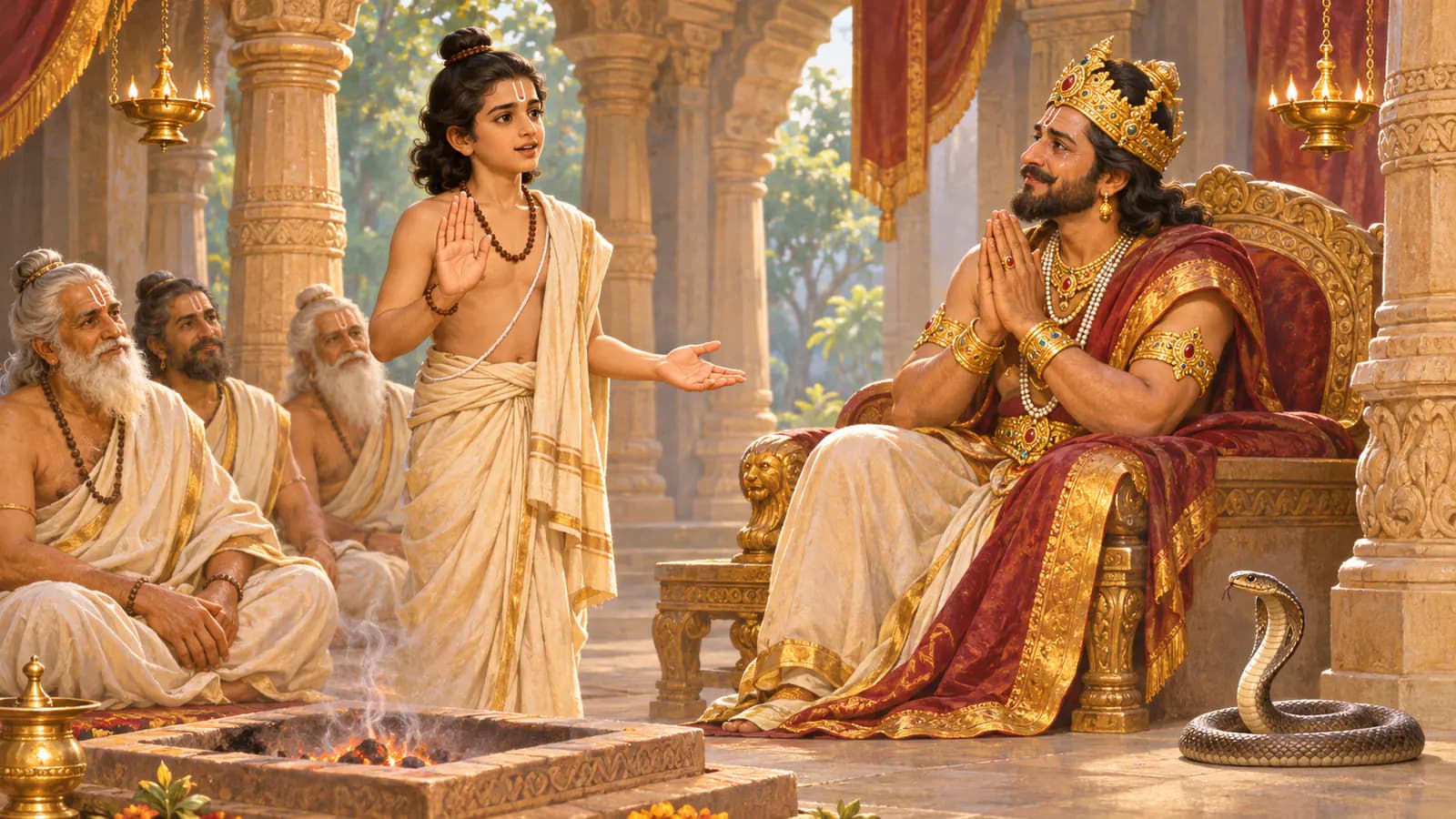
Nagula Chavithi 2026 falls on Friday, 13 November, the Chaturthi of the bright fortnight of Karthika. On this day Telugu families in Andhra Pradesh and Telangana worship the Nagas, the serpent deities, at snake anthills, and the elders tell the story of Astika, the boy who stopped a fire that snakes were falling into by the thousand.
A great fire ritual is going on, and the flames leap up to touch the sky. Every time the priests speak the mantra, snakes fall out of the sky into the fire. Not one or two, but thousands upon thousands: small snakes, snakes as big as hills, even snakes that never harmed anyone. However far they run, the mantra drags them back.
A little longer, and not a single snake would be left on earth. And right then a young boy walks into the hall, stands before the king and says one word. With that one word, the whole ritual stops. Who was that boy, and how did a child stop a fire that the greatest sages could not?
Watch the story (in English)
Nagula Chavithi 2026 date
- Date: Friday, 13 November 2026
- Tithi: Karthika Shukla Chaturthi. For Hyderabad it begins at 6:09 PM on 12 November and ends at 8:42 PM on 13 November.
- Other names: Nagula Chaviti, Naga Chaturthi (Telugu: నాగుల చవితి)
Tithi timings change with your city. You can check yours on the Nagula Chavithi festival page or the Panchangam page. The Karthika Puranam chapter for 13 November is Day 4.
What is Nagula Chavithi?
Nagula Chavithi is the festival of the Nagas. It is kept a few days after Deepavali, on Karthika Shukla Chaturthi. The Mahabharata gives us the story that families remember on this day, and it comes from the Adi Parva. Remembering it on this day and worshipping the Nagas is a custom that Telugu families have kept for generations.
The story of Astika
Kadru's curse
The story begins a long time before that fire. The sage Kashyapa had two wives, Kadru and Vinata. The children of Kadru were the Nagas, the great serpents, one thousand of them.
One day Kadru made a bet with her sister Vinata. To win it, she called her children and said, "Do one thing for me. Help me cheat." Some of the Nagas refused. "Mother, cheating is wrong. We will not do it."
Kadru was furious, and their own mother cursed them: "You who will not listen to me, you will burn in the snake sacrifice of a king named Janamejaya." A curse for telling the truth, and from their own mother's lips.
Brahma's promise
All the Nagas were terrified. Their eldest, Vasuki, went to Lord Brahma. Brahma said, "Vasuki, a mother's curse cannot be undone. But the good Nagas will not be destroyed. Your sister will marry a sage called Jaratkaru, and they will have a son. His name will be Astika. He is the one who will save you."
So Vasuki gave his sister in marriage to the sage Jaratkaru, and a son was born to them. Astika had learned all the Vedas even as a little boy, and he grew up in the home of his uncle Vasuki.
Parikshit and the young sage's curse
Time passed, and the day of the curse came closer. In Hastinapura, King Parikshit, the grandson of Arjuna, was on the throne. One day he went hunting. He grew very tired and very thirsty, and in the forest he saw a sage named Shamika sitting deep in meditation.
The king asked him for water, but the sage was keeping a vow of silence and gave no answer. Tired and angry, the king did something wrong. A dead snake was lying nearby. He lifted it with the tip of his bow, put it around the sage's neck and walked away.
The sage's son, Shringi, heard of this. He was young and could not hold back his anger. "The king who insulted my father will die within seven days, from the bite of Takshaka."
Shamika scolded his son: "The king did wrong because he was tired. You have done wrong because you were angry." But a word once spoken cannot be taken back. Parikshit understood his mistake and was full of regret. For seven days he lived under heavy guard, and still, on the seventh day, Takshaka, king of the serpents, reached him and bit him. The king died.
Janamejaya's snake sacrifice
Parikshit's son Janamejaya became king. When he grew up, he learned how his father had died, and his heart burned. "Not Takshaka alone," he swore. "I will wipe out the whole race of snakes." And he began the snake sacrifice.
The mantras began, and one by one every snake in the world was pulled towards that fire. Kadru's curse was coming true. In the world of the Nagas, Vasuki was shaking with fear. He ran to his sister. "Sister, your son was born for this very day. Send him." Astika stood up. "Uncle, do not be afraid. I am going."
The word that stopped the fire
The boy came to the hall of the sacrifice. He did not speak in anger and he did not argue. First, in the sweetest words, he praised the ritual, the king and the priests. King Janamejaya was delighted. "So much wisdom in one so young! Child, ask for whatever you wish. I will give it."
At that very moment the priests called out the name of Takshaka. He had been hiding with Indra, king of the gods, but the power of the mantra tore him loose, and he came spinning down through the sky towards the fire. Then Astika raised his hand and said one word. "Stay!" And again, "Stay!" And a third time, "Stay!" Takshaka stopped, right there in the middle of the sky.
Astika turned to the king. "O King, you promised me a boon. This is what I ask. Let this sacrifice end here. Let the Nagas who remain, live." The whole hall fell silent. Janamejaya offered him gold and cows, but Astika would not take them. "I want nothing else. Save my mother's family."
The king did not break his word. "So be it," he said. The flames died down, the snake sacrifice was over and the race of the Nagas was saved.
All the Nagas gathered around Astika. "Child, what gift can we give you?" Astika asked for nothing for himself. He said, "Whoever listens to this story with devotion, whoever remembers me, let them have nothing to fear from you." And the Nagas gladly gave their word.
What the story teaches
Notice one thing. What almost destroyed the Nagas was anger: Kadru's anger, Shringi's anger, Janamejaya's anger. And what saved them was the gentle word of a child.
How Nagula Chavithi is observed
Everyone in the house takes a head bath early in the morning, and they fast until the worship is done. Then the whole family, children and all, walks to an anthill, where snakes are believed to live.
They mark the anthill with turmeric and kumkum and place flowers on it. They pour a little cow's milk into it. They offer chalimidi, nuvvula chimmili (sweets of rice flour, jaggery and sesame), soaked lentils (vadapappu) and bananas.
And they pray, "O Naga Devata, keep our children safe." Then they take a pinch of soil from the anthill and touch it to the children's ears. The elders believe it keeps their eyes and ears healthy. That is a traditional belief, not a medical claim.
Many families also worship Lord Subrahmanya on this day, in the form of a serpent. Subrahmanya is another name of Kartikeya, and you can read his Ashtottara Shatanamavali alongside the puja.
Protect snakes, respect nature
Please remember one thing. The milk is poured at the anthill. Nobody should catch a living snake and force it to drink. That harms the snake, and the whole message of this festival is: do not harm the snake.
Why does this festival come in the month of Karthika? The elders have an answer. This is the season when the crop is ready and farmers are out in the fields, and it is the snake that eats the rats and guards the grain. So our elders taught us: do not kill it, fold your hands to it.
That is just what Astika asked for. We should not live in fear of snakes, and they should not live in fear of us. So today, as the milk is poured at the anthill, think for a moment of that boy.
Om Nagarajaya Namaha.