

Chhath Puja 2026 falls on Sunday, 15 November. It is a four-day vow to the Sun and to Chhathi Maiya, the mother who protects children, and it has a custom that almost no other festival shares: the first offering goes to the setting sun, and the second to the rising sun the next morning.
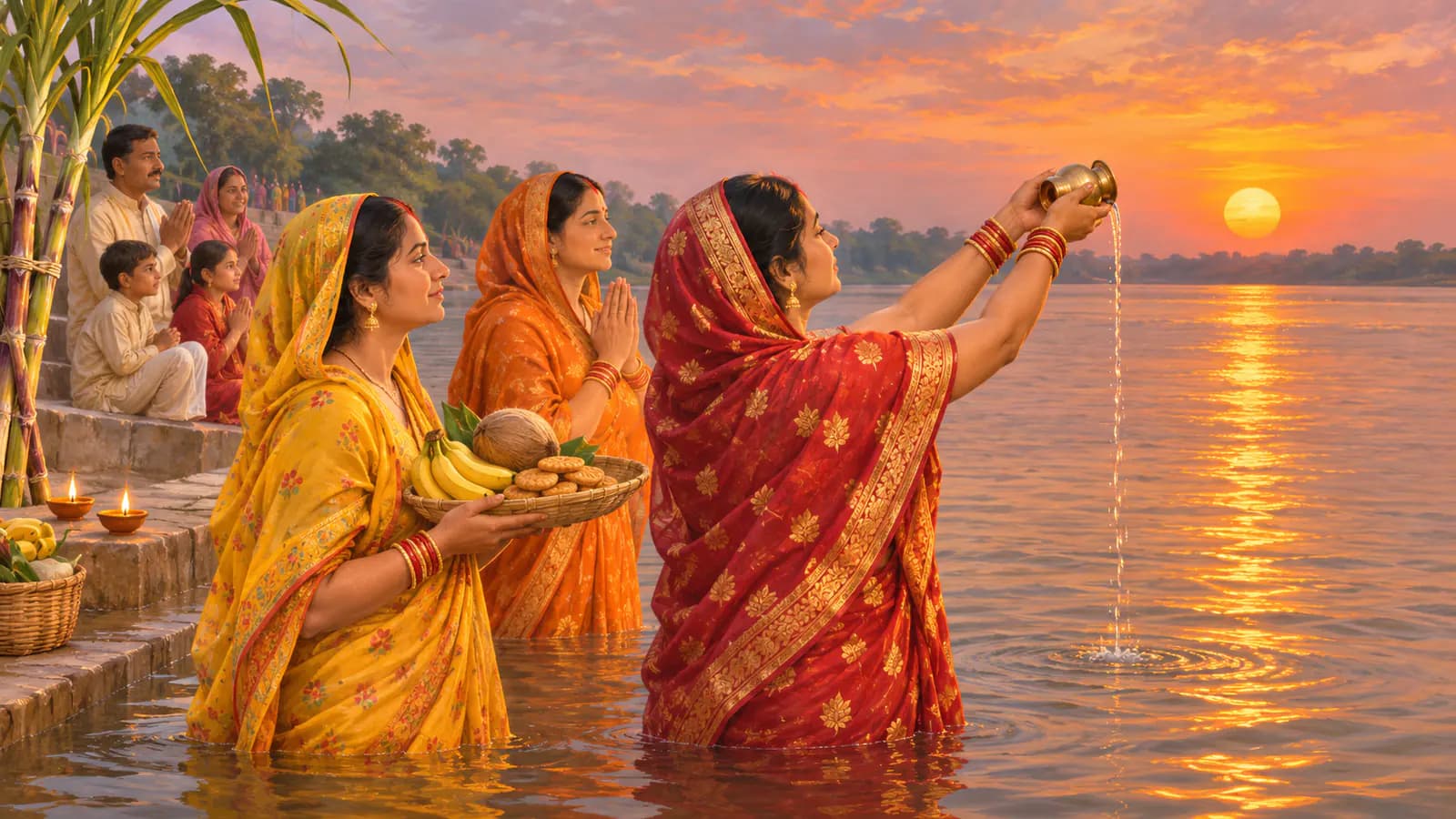
Picture the riverbank at five in the evening. Hundreds of thousands of people stand waist deep in the water, every face turned towards the west. Many of them have gone more than thirty hours without a drop of water. There is no idol in anyone's hands. A river, the Sun and a bamboo tray of fruit are all the festival needs.
Why the setting sun first? And if the offering is for the Sun, who is the Mother in every song? This article takes those questions one at a time.
Watch the story (in English)
Chhath Puja 2026 dates
| Day | Date | What happens |
|---|---|---|
| 1. Nahay Khay | Fri, 13 Nov | Bath in the river, the house is cleaned, one meal of rice, bottle gourd and chana dal |
| 2. Kharna | Sat, 14 Nov | Fast through the day; after sunset (about 4:57 PM) jaggery kheer and roti, then the waterless vow begins |
| 3. Sandhya Arghya | Sun, 15 Nov | The main day. Evening offering to the setting sun, about 4:57 PM |
| 4. Usha Arghya | Mon, 16 Nov | Morning offering to the rising sun, about 6:11 AM; the vow is completed |
Sunrise and sunset change with your city, and the arghya is timed to them, so the times above are only a guide. Check your own on the Panchangam page; the tithi timings are on the Chhath Puja festival page.
What does "Chhath" mean?
In Sanskrit the sixth day of the moon is called Shashthi. In Hindi and Bhojpuri that same word became Chhath, which simply means "the sixth". The puja is kept on the sixth day of the bright fortnight of Kartik, in the days just after Diwali.
In Bihar, Jharkhand, eastern Uttar Pradesh and Nepal, no festival is bigger. People there call it the Mahaparva, the great festival.
Who is Chhathi Maiya?
The answer is in the Devi Bhagavata, and the Brahma Vaivarta Purana tells the same story.
King Priyavrata and the child who did not breathe
Long ago there lived a king called Priyavrata, the son of Swayambhuva Manu. His queen was Malini. He had a kingdom, wealth and fame, but one sound was missing from the palace: the cry of a baby. Years passed and they still had no child.
Then the sage Kashyapa came to the king and had him perform the Putrakameshti yajna, a sacred fire ritual for a child. He gave the blessed offering from that fire to the queen. Soon she was expecting, and the whole kingdom celebrated.
The months passed and a baby boy was born, shining like gold. But the baby did not cry, did not move and did not breathe. The child had been born without life. The queen fainted, and the palace filled with weeping.
King Priyavrata lifted the tiny baby in his own hands and walked alone to the cremation ground. He held the child close to his chest and simply sat there. "What is my life worth without this child?" he thought, and he was ready to give up his own life too.
Right then a light appeared in the sky. A shining chariot of the gods, glittering with jewels, came down from above, and in it sat a goddess. Her colour was the soft white of a champaka flower, and her smile was calm and gentle. To look at her was like looking at your own mother.
The king laid the baby on the ground, stood up and folded his hands. "Mother," he asked, "who are you?" And the goddess said:
"O King, I am the daughter born from the mind of Lord Brahma. My name is Devasena. I was born from the sixth part of Mother Nature herself, and that is why I am called Shashthi Devi, the goddess of the sixth. I give children to those who have none. And I stand beside every newborn baby and keep that baby safe."
Saying this, she lifted the little baby into her arms. One moment passed. The baby opened his eyes and smiled. Priyavrata could not speak; tears were running down his face.
The promise
But the story does not end there. With the baby still in her arms, the goddess began to rise back into the sky. The king's heart almost stopped. The child who had just come back to him was being taken away again. He fell to the ground and begged, "Mother, please give me my son!"
The goddess paused and said: "O King, you rule all the three worlds. Let my worship be known in every one of them, and worship me yourself. Then this child is yours. His name will be Suvrata, and he will grow up to be a great king."
Priyavrata gave his word. The goddess placed the baby in his arms and vanished. The king went home, and from that day, on the sixth day of the bright fortnight, he held a puja for Shashthi Devi. He also announced that she should be worshipped on the sixth day after every child is born.
Devasena, the wife of Kartikeya
Remember the name the goddess gave: Devasena. She is the wife of Kartikeya, the son of Shiva and Parvati. Kartikeya has many names in many places, Skanda, Kumara, Subrahmanya, Murugan, and the goddess who stands beside him is Devasena. The Purana itself says that Shashthi Devi is the wife of Skanda.
The people of Bihar lovingly call this same Shashthi Devi Chhathi Maiya. Maiya means mother. So Chhathi Maiya is Shashthi Devi, the mother who protects little children. The Purana speaks of worshipping her on every bright-fortnight Shashthi, and Chhath, the Shashthi of Kartik, is where that worship is kept most grandly.
Why is the Sun worshipped in a Mother's puja?
This answer is in the Mahabharata. In the Vana Parva, the Pandavas have lost everything in the game of dice and have been sent to the forest. Many sages and holy men walk with them, and all of them have to be fed. But King Yudhishthira does not have a single grain of food.
Dhaumya, the teacher of the Pandavas, tells him: "O King, it is the Sun who brings the rain. It is the Sun who ripens the crops. Every living being in this world is fed by the Sun. Pray to him."
Yudhishthira stands in the river and praises the Sun with one hundred and eight names. The Sun appears and gives him a vessel called the Akshaya Patra. However many people were served from it, the food in that vessel never ran out. From that day, even in the forest, no one left the Pandavas' home hungry.
The story says something simple: behind every bite we eat, there is the Sun. Without him there is no crop and no water, and no us. That is why Chhath worships the two together, the Sun who gives life and the Mother who protects our children. The offering is for the Sun. The songs are for the Mother.
Why does Chhath begin with the setting sun?
The world usually bows to the one who is rising: the person in power, the one who is winning. Chhath bows first to the sun that is going down, the one who gave light all day and is now leaving, tired. Before anything else, the festival stops to say thank you to him.
Then it waits all through the night. At dawn, standing in the same water, it makes a second offering to the rising sun. The one who sets will rise again, and after the dark the light returns. That faith is Chhath Puja.
The four days of Chhath, one by one
Day 1, Nahay Khay (Friday, 13 November)
The name means "bathe and eat". Those who keep the vow bathe in the river and clean the whole house. They eat just one meal that day: rice, bottle gourd and chana dal, with no onion or garlic.
Day 2, Kharna (Saturday, 14 November)
A fast through the whole day. After sunset they offer a sweet rice pudding made with jaggery, along with flatbread, and then eat that. From that last bite the real vow begins: almost thirty-six hours with no food and not even water.
Day 3, Sandhya Arghya (Sunday, 15 November)
The evening offering, and the main day. The whole family walks to the riverbank. In a bamboo tray they carry fruits, sugarcane and thekua, a sweet made of wheat flour, jaggery and ghee. Standing in the water, the devotees offer milk and water to the setting sun.
Day 4, Usha Arghya (Monday, 16 November)
The morning offering, before dawn. While it is still dark they return to the river, stand in the cold water and wait for the sun. The moment the first ray appears they make the second offering. Only then do they eat the prasad, and the vow is complete.
Who can observe Chhath Puja?
Traditionally Chhath needs no priest, no idol and nothing costly: a river, the Sun, a bamboo tray and fruit from the field. Rich and poor stand side by side in the same water. It is mostly the mothers of the house who keep the vow, and in many places the men keep it too. The prayer on every lip is the same: "Mother, keep my children safe."
Anyone with a full heart can offer this puja. The full vow, though, is very hard. It is kept by families who grew up in the tradition and learned it from their elders, and if your health does not allow it, please do not attempt a fast without water.
A small offering anyone can make
On the evening of Shashthi, which this year is Sunday, 15 November, go up to your terrace, or to a river or lake nearby. It does not matter where in the world you live; the sun is the same for all of us. Take a little water in a small pot, face the setting sun and pour the water out to him as your offering. The next morning at dawn, do it once more for the rising sun.
As you do it, think of Chhathi Maiya. Say the names of your children and bow to her. She is the mother who placed a baby back in the arms of a weeping father, and tradition holds that she watches over our children too.
Jai Chhathi Maiya.