


Ten curses.
A fish. A tortoise. A boar. A lion. A dwarf…
An angry sage threw them at a king who had only sipped some water.
And now the Lord of the universe looks at that sage and says, "I will take every one of them."
What happens to a curse… when God takes it?
A Curse Taken by the Lord
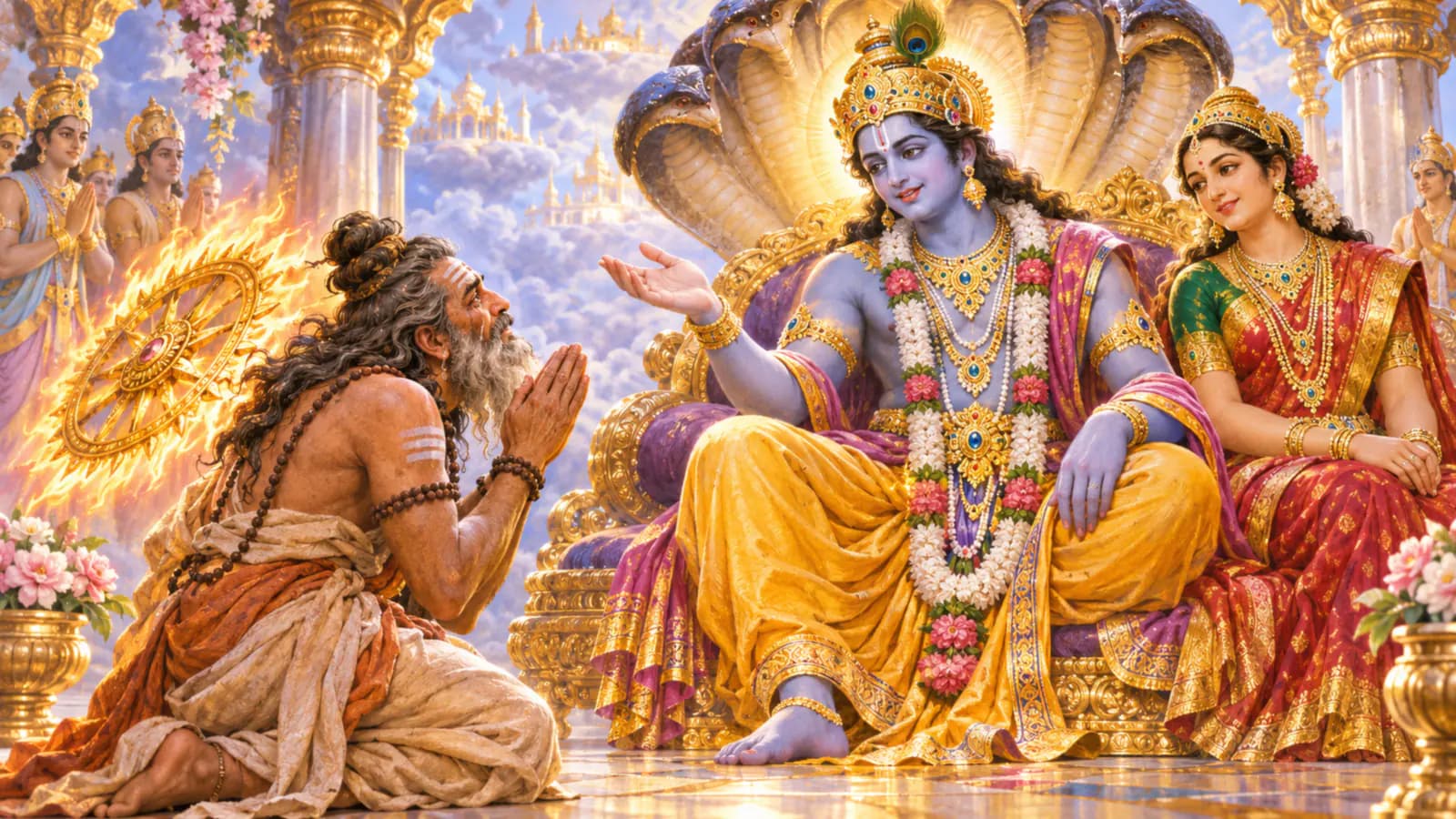
So far: the sage Durvasa cursed King Ambarisha to ten births. But Vishnu, living in the king's heart, took those curses on himself. Then he sent his discus, the Sudarshana chakra, after the sage. Now Durvasa kneels in Vaikuntha, the chakra still burning behind him. And Vishnu has fallen silent.
Then Vishnu spoke again. Gently this time.
"Durvasa, don't grieve. You are a brahmin. Your curse cannot fail. You cursed Ambarisha to ten births. But I was in his heart when you cursed. So those births have come to me."
"And your curses please me. They have turned out for the good."
"I will take those ten births as ten avatars. To punish the wicked, and to protect the good."
From Ten Curses to Ten Avatars
And one by one, the curse became a blessing for the whole world.
A fish… Matsya, who saves Manu at the great flood.
A tortoise… Kurma, who holds Mount Mandara on his back when the ocean of milk is churned.
A boar… Varaha, who kills the demon Hiranyaksha and lifts the earth up from the waters.
A lion… Narasimha, the man-lion, who destroys Hiranyakashipu.
A dwarf… Vamana, who wins back the three worlds, binds King Bali, and gives heaven back to Indra.
A cruel brahmin… Parashurama, the brahmin of fierce deeds.
A king without wisdom… Rama, who lived as a man, as if he didn't know who he was, and came to destroy Ravana.
A king without a kingdom… Krishna, of the Yadu clan.
One who walks outside the path of the Vedas… Buddha, in the age of Kali.
And a pitiless brahmin… Kalki, born a brahmin at the end of the Kali age, to destroy those who hate brahmins.
The Dashavatara. The ten great descents of Vishnu. And this chapter says they began as one sage's curse on one devotee.
Vishnu Sends Durvasa Back to Ambarisha
"So," Vishnu said, "just as you cursed, I will take ten births."
"But your own trouble is another matter. Do as I say, and the chakra will calm down."
"Ambarisha is a supreme devotee. He drank water only so that his vow wouldn't break. And now he is grieving. You left his house without eating. Your life is in danger because of him. He fears he will carry the sin of a brahmin's death. So he has sat down to fast until he dies."
"That is why my chakra is hunting you so fiercely."
Then the Lord reminded Durvasa of everyone's duty.
"A king's duty is to protect his people, not to oppress them. A brahmin's duty is to keep everyone on the path of dharma. If someone goes wrong, a brahmin guides him to set it right."
"To harm or insult a brahmin is a grave sin. And to harm or insult a devotee is just as grave."
"Durvasa, you have given up everything. You are a great ascetic. This anger doesn't suit you. Anger destroys judgement. Let it go."
"Now go to Ambarisha. Ask him for shelter. He is noble. In all creation… he alone can save you."
Durvasa had nothing to say.
Ashamed, silent, he bowed and rose. And he set out to beg for his life… from the very man he had cursed. With the chakra still blazing at his back.
A Wrong Set Right Only by Returning
Notice something here. The Lord could have called back his chakra with a single thought. He didn't. He sent the sage to the devotee. A wrong done to a devotee is set right only by going back to that devotee.
And notice the other thing. Durvasa's anger was meant to bring the king down through ten births. Instead, in the Lord's hands, those ten births became the ten avatars that protect the world.
What This Chapter Asks of Us
This chapter's practice is simple. Remember the ten avatars. It is said that whoever keeps them in mind is freed from sin. So tonight, before you sleep, say their names slowly, one by one. Matsya. Kurma. Varaha. Narasimha. Vamana. Parashurama. Rama. Krishna. Buddha. Kalki.
Read next
- Karthika Puranam – all 30 days
- Previous chapter: Karthika Puranam Day 26: No Shelter in Three Worlds
- Start from Day 1: Karthika Puranam Day 1: The River in Every Well
- Why Karthika Masam Is So Sacred: Meaning and Key Days
- Why We Light a Lamp (Deepam): Meaning, Oil, Wicks and Rules
- How to Do Tulasi Puja at Home: Method and Rules