


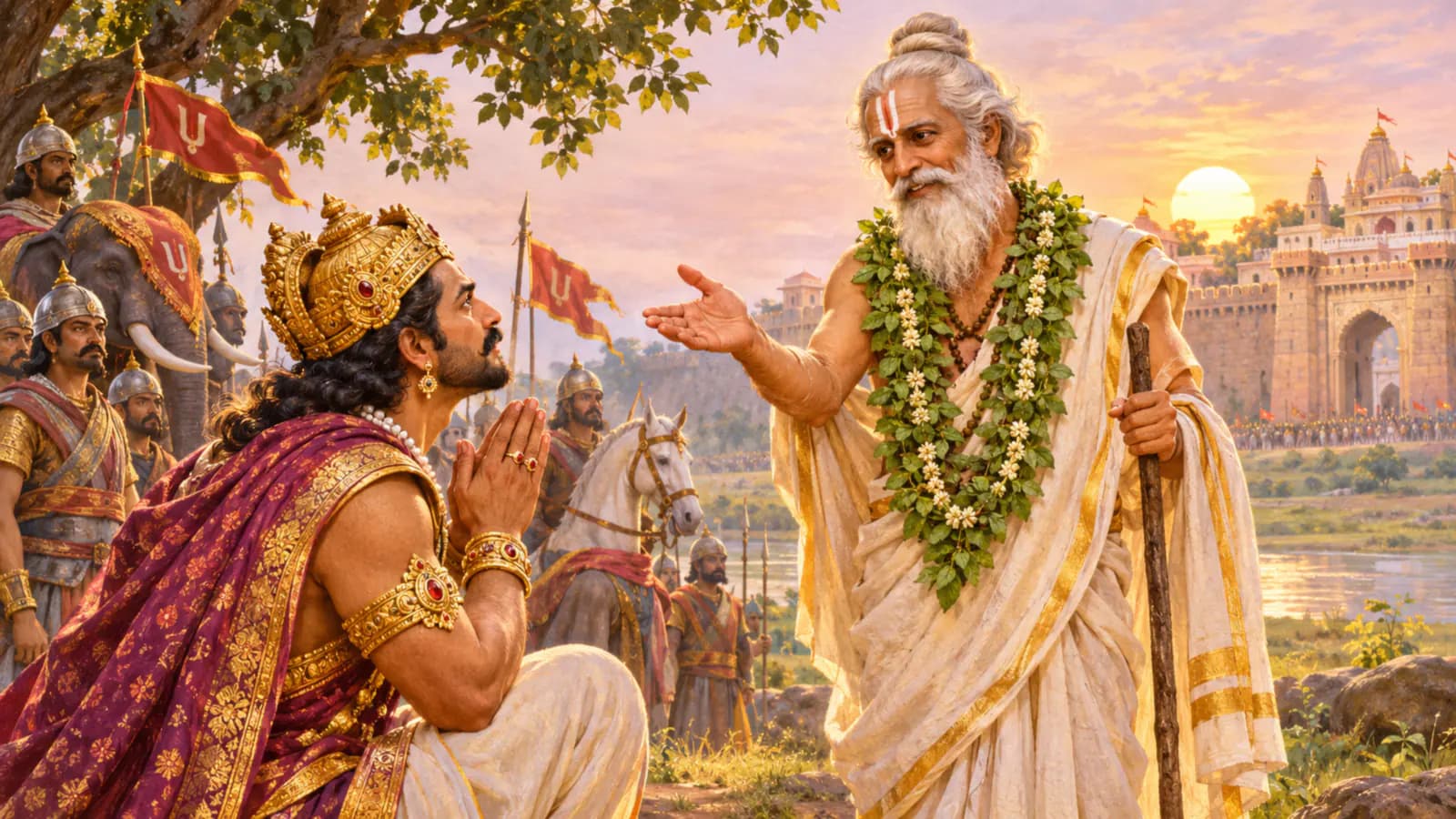
The night of the full moon is over. The sun is coming up over Ayodhya.
A king who has not slept all night is on his way home. Outside the city walls, his enemies are still waiting. His army is a fraction of what it was.
And then a stranger stands before him.
An old brahmin. His neck is covered with garlands of tulasi, the holy basil that Vishnu loves. His face is calm. He looks straight at the king and says, "King, don't grieve. Take your army. Go and fight. Now."
And before the king can say a word… the brahmin is gone. Vanished, into thin air.
Who was he? And could a king who had lost almost everything just two days ago really win today?
So far: King Puranjaya of Ayodhya, grown greedy and proud, seized the lands of temples and brahmins. The neighbouring kings, led by the king of Kambhoja, defeated him in battle. That night his family priest, Sushila, told him the way back: tomorrow is Karthika Purnima. Bathe at dawn, light lamps in the temple, and dance, singing the names of God.
A Night of Worship on Karthika Purnima
Atri told Agastya what the king did next.
Sushila's words went deep. Something in Puranjaya's heart turned.
On the day of Karthika Purnima, he bathed and purified himself. He went to the temple of Narayana. And there he worshipped the Lord with the sixteen offerings, the full traditional worship: with flowers, with fruits, with tender leaves.
Then he did something more. He had an image of Vishnu made in gold. And he worshipped that image too, with fruits and flowers.
And that night, the night of the full moon, the king did not sleep.
He stayed awake all night, singing the names of Keshava. He lay flat on the ground before the Lord, again and again. He sang. He prayed.
Think about who this is. Not long ago, this man was seizing temple lands. Now he lies on a temple floor, singing God's names until the sky grows light.
The Brahmin at Dawn and the Battle
At sunrise, he went to the river and bathed. And as he came back…
That was when the brahmin appeared. A devotee of Vishnu, his neck covered with tulasi garlands.
"King," he said, "don't grieve. Gather your army at once. Go and fight the enemy kings. Your kingdom will be yours again."
And he vanished.
Puranjaya stood there, amazed. He looked around. There was no one.
He knew this was no ordinary man.
And now his heart was full of courage. He gathered what was left of his army, and rode out once again to face the enemy kings.
The battle began again. And this time it was even fiercer than before.
But something was different.
The enemy armies could not stand against Puranjaya's soldiers. The Lord Narayana himself was helping him, in every way.
And one by one, the king of Kambhoja and the other kings lost heart… turned around… and fled.
Puranjaya had won. Ayodhya was his again.
The same king. The same city. The same enemies. Two days ago, total defeat. Today, total victory. What changed in between? One full-moon day. One night of prayer.
No God Equal to Vishnu
Atri said to Agastya, "There is no power greater than Vishnu's. He lives in every being. No one can say, 'He is here, but not there.'"
"Nothing shines like the sun. No month is equal to Karthika. And no god is equal to Vishnu."
"For one who chants the name of Hari, even an enemy becomes a friend, and even adharma turns into dharma. But without God's grace, even dharma becomes adharma… and a rope looks like a snake."
That is the teaching of this chapter. Puranjaya didn't win because his army grew bigger overnight. It didn't. He won because he turned back toward the Lord. And when the Lord is on your side, the whole picture changes.
What This Chapter Asks of Us
This chapter says a whole month of river baths and temple lamps in Karthika removes every danger. So today, keep both. Bathe at dawn, light a lamp in a temple… and say the name of Hari, the way Puranjaya did all through that night.
Read next
- Karthika Puranam – all 30 days
- Previous chapter: Karthika Puranam Day 21: A Lamp After Defeat
- Start from Day 1: Karthika Puranam Day 1: The River in Every Well
- Why Karthika Masam Is So Sacred: Meaning and Key Days
- Why We Light a Lamp (Deepam): Meaning, Oil, Wicks and Rules
- How to Do Tulasi Puja at Home: Method and Rules