


Imagine you have been a tree for more lives than anyone can count.
Standing in one place. Rain. Sun. Wind. Year after year. Life after life.
And then, one full moon night… you are a human being again. You can move. You can speak. You can think.
And the first thing you want to know is this.
"What am I? Am I this body? Was I that tree? Or am I something else?"
One man really asked this. And a great sage answered him. What did he say?
Today, there's a teaching. And a very old question.
Angirasa Answers the Man from the Pillar
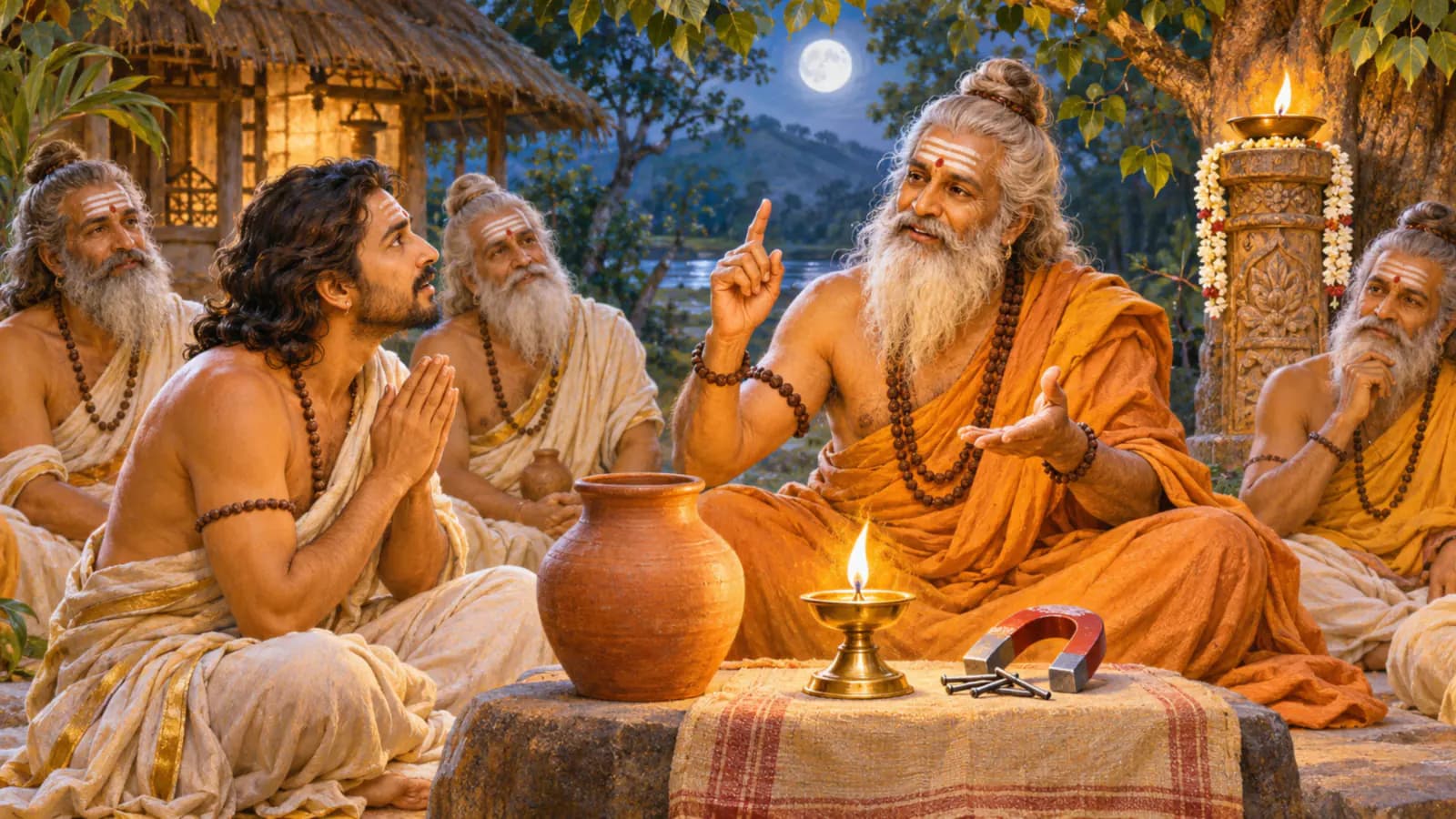
Here is where we are. Vasishtha is telling King Janaka a story. In that story, a man has just stepped out of a wooden pillar that carried a Karthika lamp, freed after countless lives as a tree. He has asked the sages, "How does karma bind a soul? And how is it broken?" And the sages have asked one of their own, the sage Angirasa, to answer him.
So today, inside Vasishtha's story, Angirasa speaks.
"Listen carefully," Angirasa said. "What I am about to tell you is not mine. Lord Shiva first taught it to Parvati, on Mount Kailasa."
"You asked how the soul gets bound. It begins with karma. Karma simply means action. Because of its actions, the soul takes a body. So karma is the cause of the body. And once there is a body, there is bondage."
"And then the soul wraps itself in that body. It says, 'I am this. This is mine. I am the one doing everything.' That feeling, 'I am the doer,' is what makes a person fall."
The man listened. Then he shook his head.
"Swami, the wise say, 'I am Brahman, I am the Supreme.' I can't understand that. If I am not this body, then what am I?"
The Pot, the Lamp and the Magnet
Angirasa smiled. And he explained it with simple pictures.
"Look at a clay pot. It was made. It can change. It can break. The body is like that pot. It is made of five elements: earth, water, fire, air and space. It changes every day. So it cannot be you. And it is not only the body. Your senses, your mind, your intellect, even your breath… none of these is you."
"Now put a lamp inside that pot. The lamp lights up the pot from within. But the lamp is not the pot. In the same way, the self lights up the body and the senses, and makes them shine. But it is not them."
"Think of a magnet. Place it near iron, and the iron moves. The magnet itself does not move at all. The self is like that. Because it is present, the senses act, the mind thinks. But the self stays still."
"And one more thing. When you wake up from a deep, dreamless sleep, you say, 'I slept well.' But in that sleep, your senses were switched off. Your mind was quiet. So who knew that you slept well? That knower. The one who watches waking, dreaming and deep sleep, and is touched by none of them. That is you."
The man was quiet now.
"Everything in the body goes through six changes," Angirasa went on. "It comes into being. It is born. It grows. It changes. It declines. And it dies. But the self does none of these. It is being. It is awareness. It is joy. When the body falls, the self does not fall with it."
"The scriptures say, Tat tvam asi. You are That. 'You' means the soul, which seems to know only a little. 'That' means the Lord, who knows everything. Set aside the 'little' and the 'everything'… and what is left in both is the same pure awareness. That is what 'I am Brahman' means."
How the Self Is Truly Known
"Then how do I come to know it?" asked the man. "Not just hear it. Know it."
And here Angirasa said the most practical thing of all.
"Not by words alone. First, do good deeds. Learn the right way from a teacher. And whatever you do, offer its fruit to the Lord. That makes the mind pure. Keep your mind calm. Keep your senses in check. Hear the truth. Think about it. Sit with it. Slowly, the knowledge becomes firm. And then the root of this endless coming and going is cut."
"Remember this," Angirasa said. "Without good deeds, there is no freedom."
What This Chapter Asks of Us
Notice something beautiful here. For countless lives, this man was a tree. And the very first thing he learns as a human being is that he was never the tree. Not even this body. Something in him was always free, and always watching.
So today, do one good thing. And when you finish it, offer it quietly in your heart. "This is for you, Lord." That is the first step Angirasa gives.
Read next
- Karthika Puranam – all 30 days
- Previous chapter: Karthika Puranam Day 16: The Man Inside the Pillar
- Start from Day 1: Karthika Puranam Day 1: The River in Every Well
- Why Karthika Masam Is So Sacred: Meaning and Key Days
- Why We Light a Lamp (Deepam): Meaning, Oil, Wicks and Rules
- How to Do Tulasi Puja at Home: Method and Rules